New publication in Proceedings in the Royal Society B titled “Mesoscale activity facilitates energy gain in a top predator.”

How animal movement decisions interact with the distribution of resources to shape individual performance is a key question in ecology. However, links between spatial and behavioural ecology and fitness consequences are poorly understood because the outcomes of individual resource selection decisions, such as energy intake, are rarely measured. Download the PDF below to read more!

Figure 4 from Abrahms et al 2018 Proceedings B B. Abrahms, K.L. Scales, E.L. Hazen, S.J. Bograd, R.S. Schick, P.W. Robinson, D.P. Costa. 2018. Mesoscale activity facilitates energy gain in a top predator. Proceedings of the Royal Society B, 285: 20181101. DOI: 10.1098/rspb.2018.1101. PDF
New publication on “Integrating Dynamic Subsurface Habitat Metrics Into Species Distribution Models”

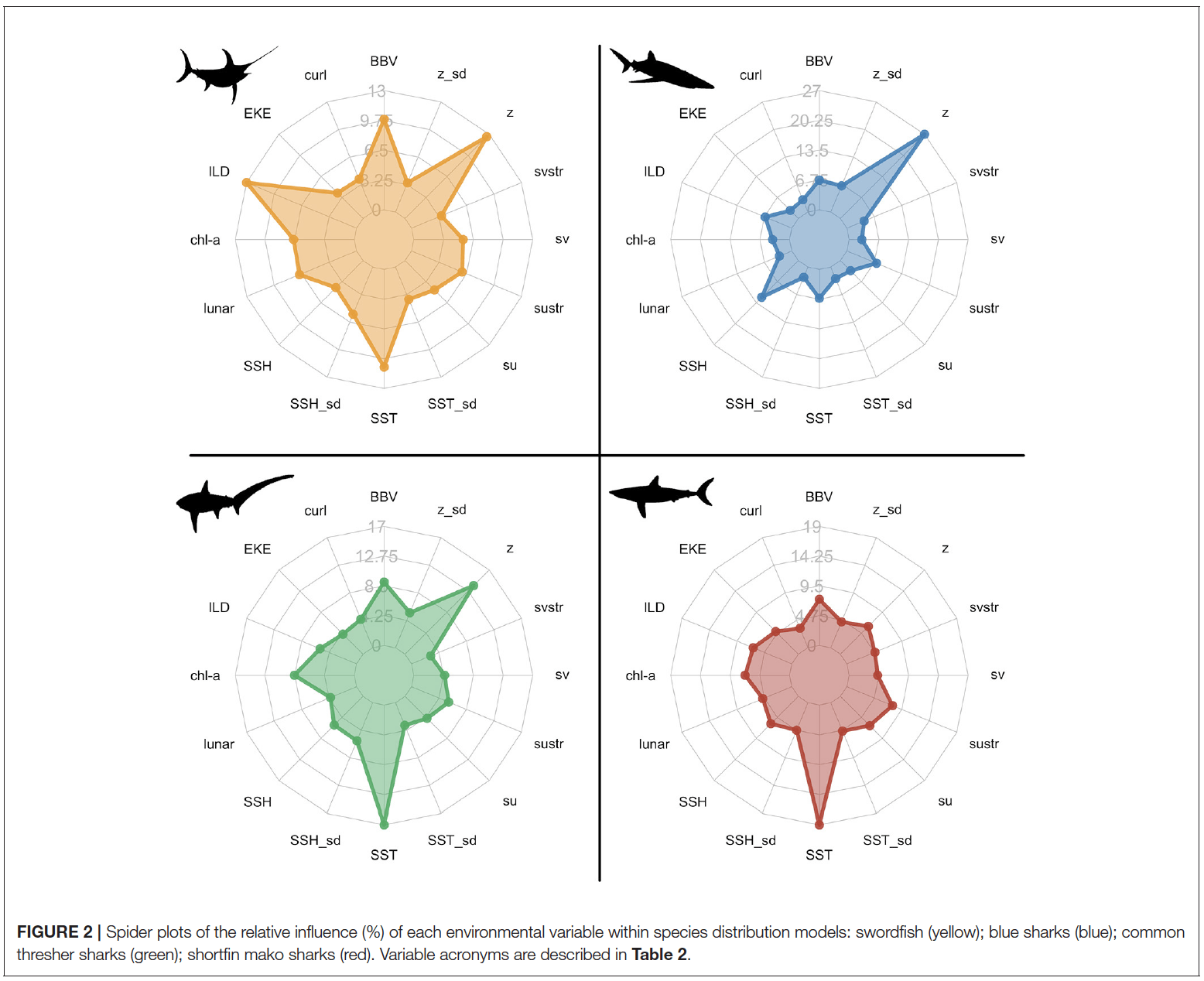
Steph Brodie published a manuscript in Frontiers in Marine Science on how we can improve habitat models by including subsurface variables.

Species distribution models (SDMs) have become key tools for describing and predicting species habitats. In the marine domain, environmental data used in modeling species distributions are often remotely sensed, and as such have limited capacity for interpreting the vertical structure of the water column, or are sampled in situ, offering minimal spatial and temporal coverage. Advances in ocean models have improved our capacity to explore subsurface ocean features, yet there has been limited integration of such features in SDMs.

Spider plots from Brodie et al. 2018

Read more below:

S. Brodie, M.G. Jacox, S.J. Bograd, H. Welch, H. Dewar, K.L. Scales, S.M. Maxwell, D.K. Briscoe, C.A. Edwards, L.B. Crowder, R.L. Lewison, and E.L. Hazen. 2018. Integrating dynamic subsurface habitat metrics into species distribution models. Frontiers in Marine Science. DOI: 10.3389/fmars.2018.00219. PDF


New publication on dynamic ocean management for the California swordfish fishery in Science Advances

New computer-generated daily maps will help fishermen locate the most productive fishing spots in near real time while warning them where they face the greatest risk of entangling sea turtles, marine mammals, and other protected species. Scientists developed the maps, the products of a system called EcoCast, to help reduce accidental catches of protected species in fishing nets.

Funded primarily by NASA with support from NOAA, California Sea Grant, and Stanford University, Ecocast was developed by NOAA Fisheries scientists and academic partners with input from fishermen and managers.

E.L. Hazen, K.L. Scales, S.M. Maxwell, D. Briscoe, H. Welch, S.J. Bograd, H. Bailey, S.R. Benson, T. Eguchi, H. Dewar, S. Kohin, D.P. Costa, L.B. Crowder, R.L. Lewison. 2018. A dynamic ocean management tool to reduce bycatch and support sustainable fisheries. Science Advances, 4: eaar3001. PDF

Continue reading

Fisheries bycatch risk to marine megafauna is intensified in Lagrangian coherent structures.

New research is out in PNAS on how dynamic features may influence bycatch risk of large predators led by Kylie Scales!

Incidental catch of nontarget species (bycatch) is a major barrier to ecological and economic sustainability in marine capture fisheries. Key to mitigating bycatch is an understanding of the habitat requirements of target and nontarget species and the influence of heterogeneity and variability in the dynamic marine environment.

K.L. Scales, E.L. Hazen, M. Jacox, F. Castruccio, S. Maxwell, R. Lewison, S. Bograd. 2018. Fisheries bycatch risk to marine megafauna is intensified in Lagrangian coherent structures Proceedings of the National Academy of Sciences. DOI: 10.1073/pnas.1801270115. PDF